
Partner perspective
A year ago I decided to learn about tournament poker. I’ve been strictly a cash game player for 20 years. I decided to start with how to play a short stack because having a stack of 20bb and less was foreign to me.
So, I was watching a popular poker coach teach short-stack tournament play.
We'd just learned how to determine whether to call someone else’s push. Now we were the ones doing the pushing.
So how do we know which hands to shove?
His answer: Put the situation into poker software and generate a chart.
Different stack sizes? New chart. Different calling ranges? New chart. Different ICM pressure? Another chart.
Keep doing that, over and over, until you develop an intuition for the right decisions.
Wait…what?
That's how I'm supposed to learn this?
I don't want to memorize thousands of answers and hope I develop a feel for them.
I want to understand how to find the answer myself.
I searched and searched. Asked pros. No one knew the answer. How to know how to adjust my pushing range based on ICM pressure and my opponent’s calling range.
It was a hidden treasure. So I began digging.
I tore the game apart for weeks. Finally, I found it. A way I could do what the solvers do. Except in my head. In seconds.
And that's why we're here.
Turns out, I've been here before.
Here We Go Again
In 2004, I started studying poker seriously. I bought books, joined forums, and tried to learn everything I could about the game.
One thing kept driving me crazy: the math.
Not because I didn't want to learn it. Quite the opposite. I wanted to understand why certain decisions made money and others didn't. But the explanations I found seemed to fall into two categories.
Either the mathematics were presented in unnecessarily complicated ways, or I was learning fascinating but largely useless facts.
How often do you flop a straight flush? Interesting, I suppose. But what am I supposed to do with that information?
I wanted to understand the mathematics that actually influenced my decisions at the poker table. And I wanted to understand them well enough to use them.
Once I figured out how the important concepts fit together, I kept asking myself, “Why hasn't someone made this easier to understand?”
That experience eventually led me to write Poker Math That Matters.
More than twenty years later, I found myself asking exactly the same question.
Except this time, the subject was tournament poker.
Tournament Poker Has a Teaching Problem
Consider a typical approach to tournament poker education.
First, we learn about ICM—the Independent Chip Model. It helps explain why tournament chips don't have a constant monetary value.
Fair enough. Important stuff.
Next comes Bubble Factor, which helps measure how much more expensive losing a confrontation can be than the benefit of winning it.
Also important.
Then Risk Premium, which translates that pressure into an additional equity requirement.
Now we're getting somewhere! That's a number I can actually use.
But eventually, we arrive at the question I've been trying to answer all along:
Should I push all-in or fold?
Suddenly, the practical advice becomes something like this: run the situation through a solver, study the chart, memorize the result, and develop an intuition for similar situations.
Really?
Change the stack sizes. New chart.
Change the payout structure. New chart.
Change how frequently your opponent calls. Another chart.
We have extraordinary software capable of producing extremely sophisticated answers. I'm not disputing that.
But calculating the answer and teaching somebody how to arrive at it are two entirely different things.
Suppose someone tells you that your opponent calls too frequently, so you should tighten your pushing range.
Great advice.
How much tighter?
Suppose you're near the money bubble and the ICM pressure increases.
You should adjust your strategy.
Wonderful.
How much should you adjust?
Those are the questions I wanted answered.
And despite all the poker educational material I explored, I wasn't finding the kind of practical, comprehensive training system I was looking for.
So I started building one.
Video: An Introduction to the All-In Equity Method
The Idea Behind All-In Equity Method
My objective was straightforward.
I wanted to understand the numbers behind short-stack tournament decisions well enough to make useful estimates in my head, in seconds, while actually playing.
No solver at the table. No endless collection of push/fold charts to memorize.
I spent a great deal of time pulling apart the mathematics behind calling and pushing all-in.
How much equity does my hand have? How much equity does this particular situation require?
The complete mathematics can become extraordinarily complicated.
But after considerable experimentation, I found ways to simplify the important relationships into practical estimates.
Those discoveries became the All-In Equity Method, or AEM.
The fundamental idea is to understand what a situation requires and compare it with what your hand offers.
That's the philosophy.
Two Questions. One Hand.
The entire method comes down to two questions:
How much equity do I need?
How much equity do I have?
That's it. We figure out what the situation requires, estimate the equity of the hand we're actually holding, and compare the two.
We don't work with hand charts. We're focused on the one hand in front of us.
Of course, if we went through this process for all 169 starting hands, we'd end up with a hand chart.
But why distract ourselves with the other 168 hands we're NOT holding?
While Tournament Poker is incredibly nuanced, we truly can simplify this process.
Video: How Good is Your Poker IQ
But I quickly realized something else.
Explaining this method wasn't enough. Players need a way to internalize it.
And that's where AEM became much more than a conventional poker course.
Learning Something Isn't the Same as Being Able to Do It
This is one of the biggest distinctions between AEM and traditional poker training.
You can watch an explanation of a concept, understand every word, and still struggle to apply it twenty minutes later.
I can explain how Risk Premium affects a tournament decision. You might understand it perfectly.
But what happens when you're sitting at a table with ten big blinds, facing a decision, and the clock is ticking? Different, right?
That’s why I wanted an entire interactive training environment where players could practice the individual skills, receive feedback, recognize patterns, and eventually combine everything into realistic poker decisions.
The course teaches the concepts.
The tools teach you to use them.
Video: More Than a Poker Course
Hand Equity Training: Know What Your Cards Are Actually Worth
It has amazed me how few tournament players know hand equities. We take the time to understand pot odds, risk premium, etc. We end up with a number of the equity we need. But that effort is worthless if we don’t know the equity our hand has. Why bother?
Ask a poker player how much equity ace-king has, and you'll probably get an answer.
Then ask: Against what range?
That's when things get interesting.
Hand equity isn't a fixed number attached to your two cards. It changes with the hands your opponent might hold.
And when multiple opponents enter the pot, the relationships change again.
AEM includes a comprehensive Hand Equity Training system covering all 169 starting-hand classes, organized into practical groups.
Players can study traditional flashcards or practice with interactive multiple-choice questions. The training includes heads-up and multiway situations, along with different opponent ranges.
Rather than memorizing isolated equity figures, you're learning how hands behave.
Which hands perform particularly well against tight ranges? Which improve dramatically as ranges widen? Which hold up surprisingly well against several opponents?
Knowing whether your hand has approximately 35% equity or 45% equity can completely change a decision.
And that's not a detail we leave to guesswork.
Risk Premium Training
Again, I’ve been amazed how few tournament players know how to estimate their Risk Premium. My hunch is because they wouldn’t know what to do with the number if they could get it.
AEM changes that.
We built an interactive ICM Pressure Explorer, available free to AEM users: https://app.allinequitymethod.com/free_poker_challenges
It allows players to experiment with prize pools and stack sizes to watch how ICM pressure changes.
It's a visual way to understand the concepts behind tournament risk.
However, the full program goes much further.
AEM includes an ICM Pressure Scale and dedicated Risk Premium training, designed to help players estimate the pressure associated with different tournament situations.
The objective isn't to turn players into walking ICM calculators.
It's to develop practical estimates that are accurate enough to improve real decisions.
We've all heard that ICM matters.
I want players to learn how to make it matter.
The Quiz Builder: Where Everything Comes Together
This is where I think the program becomes particularly interesting.
You can learn individual concepts separately. You can practice hand equity, Risk Premium, and equity requirements.
Eventually, though, you need to put them all together.
That's the purpose of the AEM Quiz Builder.
It contains a massive library of customizable short-stack push/fold situations, with hundreds of thousands of possible training scenarios.
Players can filter situations according to stack sizes, positions, tournament pressure, opponent behavior, and other relevant factors.
You're presented with a realistic decision.
Push or fold?
You make your choice, receive feedback, and examine the reasoning behind the correct answer.
More importantly, you can train on the particular kinds of situations where you struggle.
Instead of running through random material indefinitely, you can focus your practice.
I wanted something that would allow players to identify weaknesses, work on them deliberately, and see improvement.
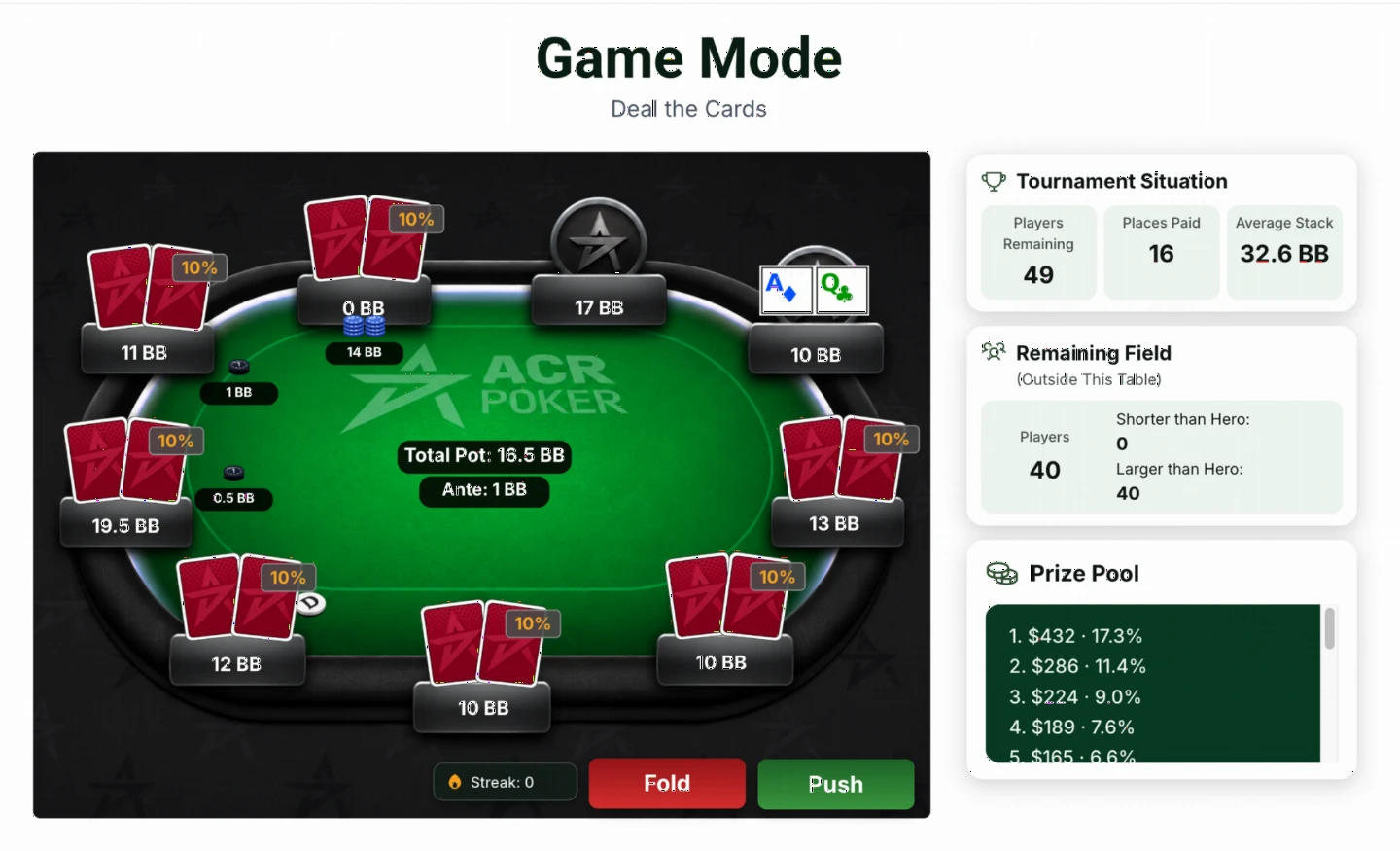
Game Mode: Cards in the Air
Now it's time to put it all together. Cards in the air.
Game Mode puts you at a poker table, with your cards in front of you, your opponents' strategies on display, and the tournament lobby right beside you. You can see the stacks, the players remaining, the payouts, and the pressure of the situation.
No charts. No solver. Just you, the hand you're holding, and a decision to make.

Push or fold?
After each hand, you can dig into an in-depth explanation of why pushing or folding was the right decision. How much equity did you need? How much did your hand have? What role did the opponents' calling ranges and ICM pressure play?
Built for the Player Who Wants to Understand
Who is All-In Equity Method for?
It's for tournament players who are sick of sitting at the table with their short stack wondering what a solver would tell them to do.
It's for players who have watched poker training videos, studied charts, and run solver simulations but still struggle to adjust when circumstances change.
It's for recreational players who don't want to spend years becoming experts in poker software before they can make better decisions.
You don't need to be a mathematician.
The program is specifically designed to make complicated poker relationships manageable through understandable numbers, repeated practice, and practical adjustments.
Our focus is short-stack tournament play, generally around fifteen big blinds or less.
That's deliberate.
When stacks are short, the decisions become more manageable, and the underlying principles become easier to isolate.
It's an excellent place to develop the skills that influence tournament poker decisions.
The Point of All This
Twenty years ago, I wrote Poker Math That Matters because I believed that the most important poker mathematics could be taught more simply.
Today, I believe the same thing about short-stack tournament poker.
The tools have become more powerful. The software has become more sophisticated. The answers have become more precise.
But the fundamental challenge for the player hasn't changed.
You still have to make the decision.
Poker is complex. Making the right decision doesn't have to be.
That's why I built the All-In Equity Method.
And that's what I want to teach.
Owen Gaines is a professional poker player, the author of Poker Math That Matters, and the creator of All-In Equity Method, an interactive short-stack tournament poker training program.