
Skip to learning content

Poker hand rankings

Poker Hand Rankings

Learn every poker hand in order, with clear examples, tie-break rules and a printable chart. Then test your eye in a five-card showdown.

A close view of playing cards and poker chips

Poker hands in order

Strongest at the top, weakest at the bottom. Open a hand for a quick explanation.

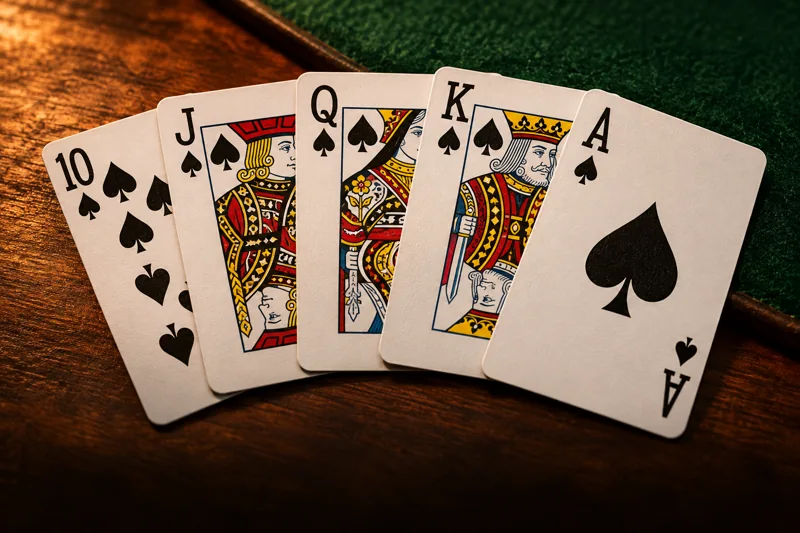
  1. 1Royal flushThe ace-high straight flush. Nothing beats it in standard high poker.

    All five cards must share a suit. A royal flush is the ace-high straight flush, the highest hand under standard high-hand rules.

    Explore royal flush in detail →
  2. 2Straight flushFive consecutive cards of one suit. Compare the highest card.

    Compare the top card of the five-card sequence. A-2-3-4-5 of one suit is five-high; the ace does not make that low sequence ace-high.

    Explore straight flush in detail →
  3. 3Four of a kindFour cards of one rank, plus a kicker.

    Compare the rank of the four matching cards first. When quads are shared on the board, the best eligible fifth card can decide the pot.

    Explore four of a kind in detail →
  4. 4Full houseThree of a kind plus a pair. Compare the trips first.

    Compare the three-of-a-kind rank before the pair. Jacks full of eights beats tens full of aces, because the trips are compared first.

    Explore full house in detail →
  5. 5FlushFive cards of one suit. Compare cards from highest to lowest.

    Compare the five suited cards from highest to lowest. The suit name does not decide a tie, and a full house beats a flush in standard high poker.

    Explore flush in detail →
  6. 6StraightFive consecutive ranks. An ace can be high or low.

    The highest card names the straight. A-2-3-4-5 is valid; Q-K-A-2-3 is not. Equal straights do not get an extra sixth-card kicker.

    Explore straight in detail →
  7. 7Three of a kindThree equal ranks, plus two kickers.

    A set usually uses a pocket pair; trips usually uses one private card and a paired board. Both are the same hand category at showdown.

    Explore three of a kind in detail →
  8. 8Two pairTwo pairs of different ranks, plus a kicker.

    Compare the higher pair, then the lower pair, then the remaining kicker. Aces and threes beat kings and queens because the top pair is higher.

    Explore two pair in detail →
  9. 9One pairOne pair and three kickers.

    Compare the pair first, then the three kickers from highest to lowest. Hole cards that do not enter the best five do not break a tie.

    Explore one pair in detail →
  10. 10High cardNo pair, straight or flush. Compare all five cards in order.

    Compare all five cards in descending order. If every relevant rank matches, the hands tie; an unused card or a different suit cannot change that.

    Explore high card in detail →

Standard 52-card high-hand rules. Short deck, lowball and casino variants can differ. At showdown, only your best five eligible cards count.

How to read a poker hand

The small details that settle the most common questions.

Part of Poker hand rankings in the Beginners Hub.

Standard high poker ranks five-card hands from royal flush down to high card. A full house beats a flush; a flush beats a straight; three of a kind beats two pair. In Texas Hold’em, choose the best five of seven available cards using zero, one or two hole cards.

What are poker hands in order?

  • Royal flush: A-K-Q-J-10 of one suit.
  • Straight flush: five consecutive cards of one suit.
  • Four of a kind: four equal ranks.
  • Full house: three of a kind and a pair.
  • Flush: five cards of one suit.
  • Straight: five consecutive ranks.
  • Three of a kind: three matching ranks.
  • Two pair: two distinct pairs.
  • One pair: two matching ranks.
  • High card: none of the combinations above.

How are ties broken?

Compare the defining ranks first: pair, trips or top straight card. Compare kickers only when needed. With two pair, compare the higher pair, lower pair, then kicker. With flushes and high card, compare five cards in descending order. Identical five-card values split the pot. Suits do not break ordinary Hold’em ties.

Is an ace high or low?

A-2-3-4-5 is a five-high straight; 10-J-Q-K-A is ace-high. Q-K-A-2-3 is invalid because straights cannot wrap. A royal flush is the highest straight flush, so mathematical counts usually include it within that category.

How many hands exist?

A 52-card deck has 2,598,960 unordered five-card combinations. They form nine categories when royal flushes are counted with straight flushes. Hold’em river probabilities differ because you select five from seven available cards.

Can you print a chart?

Use the visual reference below. The print button opens a clean layout for printing or saving as PDF in your browser. Check house rules before using aids during play. Lowball and short deck can need different charts.

Where should you go next?

Continue with starting hands by position or poker terms A–Z.

Put the idea into practice

Two hands. One board.
Can you spot the winner?

Take your time. Choose a hand to reveal the best five cards and understand why it wins.

Example 1 of 5 · A draw becomes a made hand

SHARED BOARD

Hand A

Hand B

THE FIVE-CARD RULE

Read the whole board.

Start with the hand category. If it matches, compare the ranks and relevant kickers. Ignore any sixth or seventh card.

See this example explained

Hand A makes an ace-high flush. Hand B has three queens. A flush beats three of a kind; the strongest-looking hole cards do not decide by themselves.

Standard 52-card Texas Hold’em, at showdown. Educational examples only. No money, account or timed decisions.

Explore each hand in detail

From your first pair to the strongest hand in poker. Follow the examples at your own pace.

A quick confidence check

Test yourself

Which hand beats a flush in standard high poker?

See the answer

Full house. A full house ranks above a flush. A straight and two pair rank below it.