
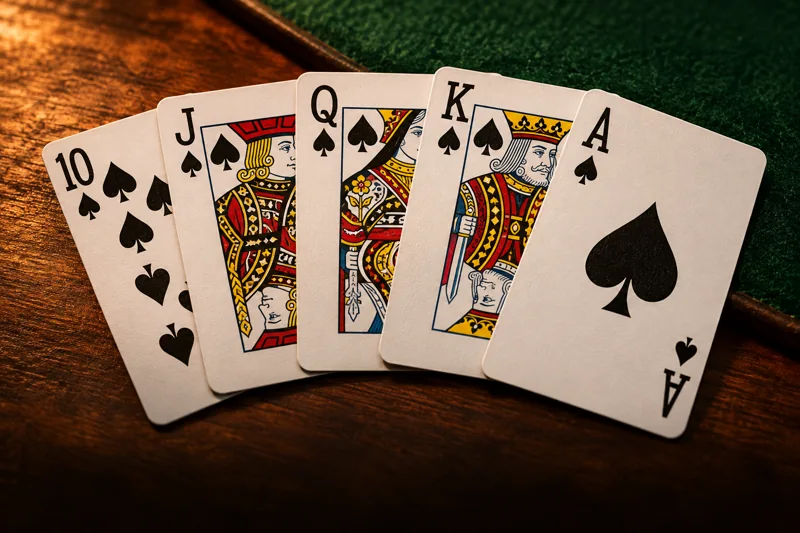
Part of Poker hand rankings in the Beginners Hub.
A flush is five cards of the same suit in standard high poker. They do not need consecutive ranks; five consecutive same-suit cards form a straight flush. A flush beats a straight and loses to a full house.
Which flush wins?
Compare the five flush cards from highest to lowest. A-J-8-6-3 beats K-Q-10-9-7, regardless of suit, because an ace outranks a king. If the highest cards tie, continue to the next difference. Suit names do not decide ordinary Hold’em showdowns.
What is a flush draw?
Four cards of one suit with cards still to come make a draw. Nine of that suit’s thirteen cards remain unseen, but not necessarily all are winning outs. Completing a flush can still lose to a higher flush or full house.
Must you use both hole cards?
Not in Hold’em. With four hearts on the board, a single A♥ can complete your best flush. With five board hearts, everyone can play the board, but a hole card may improve it. Omaha instead requires exactly two private cards.
Does a flush beat a full house?
No under standard high rankings. Some short-deck rules reverse these categories. Identify the variant before applying a chart, and count five eligible same-suit cards rather than assuming a colorful board makes a flush.
Where should you go next?
Continue with starting hands by position or poker terms A–Z.