

KEY TAKEAWAYS
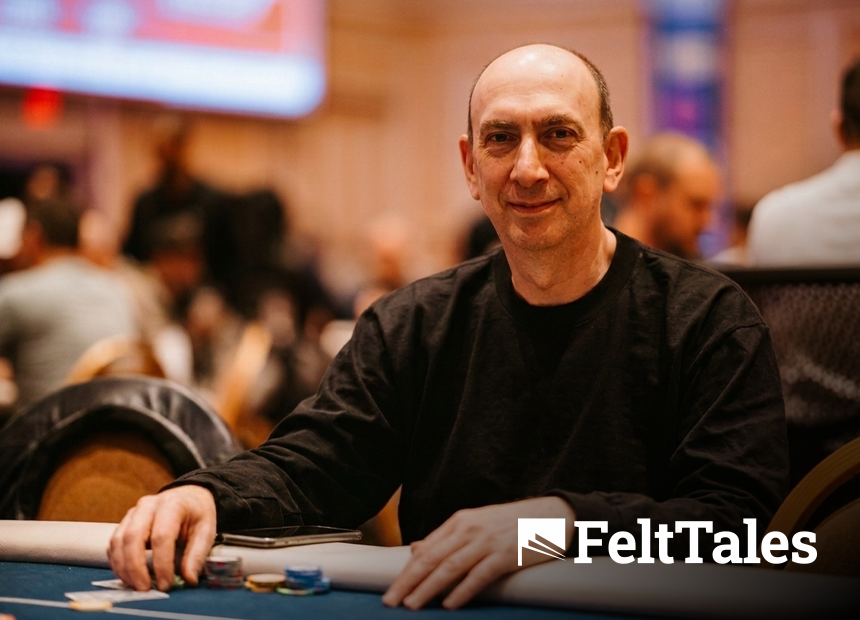
Erik Seidel is best known to many fans as the man who lost to Johnny Chan in the movie Rounders. That clip shows the start of his career, not its peak. Seidel, a New Yorker who came to poker from backgammon and Wall Street, has since won 10 World Series of Poker bracelets, a World Poker Tour title and high roller tournaments with buy-ins of up to A$250,000.
He was inducted into the Poker Hall of Fame in 2010. As of November 2026, the Hendon Mob database credits him with $49,303,842 in live tournament earnings, and WSOP.com lists him tied for third on the all-time bracelet list. His results span several eras of the game, from limit hold’em bracelets in the early 1990s to super high roller events in the 2020s.
This profile covers who Erik Seidel is, how he came to poker, the main milestones of a career that began in 1988, how he is publicly described, and the parts of his record that are less flattering, including his association with Full Tilt Poker.
From Backgammon and Wall Street to Poker
Seidel was born on November 6, 1959, in New York City, according to WSOP.com and PokerNews. Before poker, he was a professional backgammon player, a background he shares with fellow Hall of Famer Dan Harrington.
The Poker Hall of Fame announcement published by WSOP.com in 2010 describes Seidel and Dan Harrington as former tournament backgammon players who played at the Mayfair Club in New York. The club began as a backgammon and bridge venue and became better known for the poker players it produced. PokerNews lists Stu Ungar, Howard Lederer, Steve Zolotow and Harrington among the players Seidel learned alongside there.
Seidel also worked in finance. The same 2010 announcement says he had a short career as an options trader and turned to poker after the stock market crash of 1987. PokerNews notes that he was initially a cash game player before becoming best known for tournaments.
His first recorded tournament result came almost immediately. At the 1988 WSOP Main Event, the then 28-year-old outlasted 165 competitors to reach heads-up play against Johnny Chan, according to WSOP.com. He finished second and won $280,000, PokerNews reports. The final hand of that match was later shown in Rounders, the 1998 film that, in WSOP.com’s description, inspired generations of players.
Erik Seidel’s Poker Career, Era by Era
The bracelet years: 1992 to 2007
Seidel’s results in the early 1990s showed that 1988 was no accident. PokerNews records another second-place WSOP finish in 1991, then his first bracelet in the $2,500 limit hold’em event in 1992. He added a second in 1993 in $2,500 Omaha hi-lo and a third in 1994 in $5,000 limit hold’em.
His fourth bracelet came in 1998 in the $5,000 no-limit deuce-to-seven draw event, a win also recorded in Card Player’s recap of that year’s series. A year later, PokerNews reports, he reached the 1999 Main Event final table and finished fourth. Bracelets five through eight followed in 2001 (no-limit hold’em, $411,300), 2003 ($1,500 pot-limit Omaha), 2005 ($2,000 no-limit hold’em, $611,795) and 2007 (the $5,000 no-limit deuce-to-seven draw world championship, $538,835).
Beyond the WSOP
In 2008, according to PokerNews, Seidel finished second in the Aussie Millions Main Event for A$1,000,000 and then won the WPT Foxwoods Poker Classic Main Event for $992,890, his only World Poker Tour title.
His biggest year came in 2011. The Hendon Mob records a win in the A$250,000 Aussie Millions Super High Roller for A$2,500,000 ($2,472,555), still his largest single cash, along with first place in the NBC National Heads-Up Championship for $750,000 and a $100,000 Super High Roller win in Las Vegas for $1,092,780. Poker.org puts his 2011 total above $6.5 million. The Hendon Mob lists his best-ever rank on its all-time money list as first.
The high roller results continued. PokerNews records a win in the €100,000 Super High Roller at the 2015 EPT Grand Final for €2,015,000 ($2,222,222) and third place in the 2016 Super High Roller Bowl for $2,400,000.
Bracelets nine and ten
After a 14-year gap, Seidel won his ninth bracelet in August 2021 in the $10,000 Super MILLION$ High Roller, an online WSOP event on GGPoker, for $977,842, according to PokerNews and Poker.org. In December 2023, at the first WSOP Paradise in the Bahamas, he won the $50,000 Super High Roller for $1,704,400, his 10th bracelet. WSOP.com describes it as his only seven-figure WSOP cash.
He remains active. WSOP.com lists a second-place finish in the $3,000 6-handed pot-limit Omaha event at the 2026 WSOP, worth $271,371, and the Hendon Mob records a PokerGO Tour pot-limit Omaha win in October 2025.
| Year | WSOP bracelet event | Prize (where reported) |
|---|---|---|
| 1992 | $2,500 Limit Hold’em | — |
| 1993 | $2,500 Omaha Hi-Lo | — |
| 1994 | $5,000 Limit Hold’em | — |
| 1998 | $5,000 No-Limit Deuce-to-Seven Draw | — |
| 2001 | No-Limit Hold’em | $411,300 |
| 2003 | $1,500 Pot-Limit Omaha | — |
| 2005 | $2,000 No-Limit Hold’em | $611,795 |
| 2007 | $5,000 No-Limit Deuce-to-Seven Draw World Championship | $538,835 |
| 2021 | $10,000 Super MILLION$ High Roller (online) | $977,842 |
| 2023 | $50,000 Super High Roller (WSOP Paradise) | $1,704,400 |
The table lists Seidel’s 10 bracelets as reported by PokerNews, Poker.org, Card Player and WSOP.com. Prize amounts are shown only where those sources give them.
Why Seidel Matters to Poker
Seidel’s significance is mostly about range and longevity. His bracelets span hold’em, Omaha and deuce-to-seven lowball, and his wins stretch from the limit games of the early 1990s to the online and super high roller events of the 2020s. WSOP.com counts 74 WSOP final tables and 236 cashes on his record.
He has also shaped how others learned the game. Poker.org notes that, although he has never worked as a coach, he mentored author Maria Konnikova, who wrote about the experience in her book The Biggest Bluff. And his appearance in Rounders means the film’s depiction of a WSOP final features a player who went on to a Hall of Fame career. WSOP.com, describing his record, says he is regarded as one of the best players to ever play the game; that is a widely shared assessment rather than a measurable fact.
The Other Side of the Record
Tournament earnings are not profit. Totals like Seidel’s $49 million count prizes won, not buy-ins paid, and the high roller events above cost between $25,000 and A$250,000 to enter. PokerNews notes that only Seidel knows his net worth.
His career also includes an association with Full Tilt Poker. PokerNews reports that Seidel was a sponsored member of Team Full Tilt, the online site that closed owing players more than $300 million combined. He was not thought to be part of its management, according to PokerNews, and he has said he was disgusted at how the company was run. The episode remains part of how many players remember that era.
Myths About Erik Seidel
Myth: he is mainly famous for losing in Rounders. The 1988 hand is his best-known moment on screen, but it came in his first major tournament. Ten bracelets and a Hall of Fame induction followed.
Myth: he is a hold’em-only player. His WSOP titles include Omaha hi-lo, pot-limit Omaha and two deuce-to-seven draw events, according to PokerNews.
Myth: $49 million in earnings means $49 million in profit. As with any tournament player, the figure is gross prize money before buy-ins and other costs.
Related Stories on FeltTales
The hand that introduced Seidel to a wider audience is retold in the 1988 Chan vs. Seidel final hand, and the player on the other side of it is covered in the FeltTales profile of Johnny Chan’s career and bracelets. For the film that made that hand famous, read how the Rounders movie changed poker culture. Seidel’s 10th bracelet came at the event described in the WSOP Paradise trip guide, and the only player with more WSOP titles is profiled in Phil Hellmuth’s career and bracelets.