


KEY TAKEAWAYS
Few World Series of Poker titles have been decided by a single card as cruelly as the 2000 Main Event. On the last hand, Chris “Jesus” Ferguson called an all-in from T.J. Cloutier holding ace-nine, only to see that Cloutier held ace-queen. Ferguson was in deep trouble with one card to come, and then a nine landed on the river. That card made him world champion and was worth $1,500,000, at the time the largest first prize the event had ever paid, according to Card Player’s history of that year.
The hand matters for more than its drama. It ended a heads-up match in which Cloutier, one of the most accomplished tournament players of his generation, had clawed back from roughly a ten-to-one chip deficit. It denied him the one title that eluded him. And it launched Ferguson into a decade of fame that would later be overshadowed by the collapse of Full Tilt Poker. This article retells the final hand street by street, using contemporary reports from the event, Card Player and ESPN, and notes where those accounts disagree. It also covers how both players got there, why the hand is still discussed, and what came after for each of them.
The Road to Heads-Up at the 2000 Main Event
The 2000 Main Event drew 512 entrants at $10,000 each, which Card Player notes was large enough to delay the start of Day 1 by two hours while seats were found. The field was growing, but it was still a few years before the televised boom that followed Chris Moneymaker’s 2003 win. Forty-five places were paid, according to the results published by ConJelCo.
Ferguson arrived at the final table as the dominant stack. He bagged 2,853,000 chips going into the final day, according to Mike Paulle’s report for ConJelCo, while Cloutier sat sixth of six with just 216,000. Ferguson had built that stack late on the previous night, winning a big pot with pocket sixes against Jeff Shulman’s sevens and then holding pocket aces against Shulman’s kings in a three-way confrontation in which Cloutier folded jacks.
The final table moved quickly. Ferguson eliminated Roman Abinsay in sixth with pocket eights against ace-queen. Writer Jim McManus, who had entered through a satellite while on assignment for Harper’s Magazine, went out in fifth and later turned his run into the book Positively Fifth Street. Ferguson then knocked out Hasan Habib and Steve Kaufman to reach heads-up play. Card Player reports that the whole sequence took only about an hour.
Cloutier had largely waited while the others fell. Paulle’s report notes that tournament director Bob Thompson had told the crowd that a second-place finish would make Cloutier the all-time WSOP money leader, passing Johnny Chan. When Kaufman busted in third, that milestone was secured before the heads-up match even began.
The Final Hand, Street by Street
Heads-up play did not go the way the chip counts suggested. According to ConJelCo, Cloutier started the duel with about one-tenth of Ferguson’s chips. Card Player describes how he doubled up with trip tens, then saw two big all-in pots end in splits, and even took a slight chip lead with three kings. Ferguson regained a small edge, but by the final hand the two stacks were much closer than they had been an hour earlier.
Preflop: The Raise, the Shove and the Long Think
Card Player’s account says Cloutier raised to 175,000, Ferguson reraised to 600,000 and Cloutier moved all in. ConJelCo’s report instead describes Cloutier going all in for almost $2.5 million over an initial raise by Ferguson, so accounts differ on exactly who opened the betting. All sources agree on what followed: Ferguson took a long time to decide. Card Player says he thought for five full minutes and, unusually for him, removed both his hat and his sunglasses before calling.
When the cards were turned over, Ferguson showed ace-nine and Cloutier showed ace-queen. In ESPN’s retelling, Ferguson held A♠ 9♣ and Cloutier held A♦ Q♣. Both players shared an ace, so the queen kicker made Cloutier roughly a three-to-one favorite, as ESPN’s Bernard Lee put it. The crowd, ConJelCo reported, gasped at the sight of the hands.
The Flop and the Turn
The flop came K♣ 4♥ 2♥ in ESPN’s account. Nothing changed: Cloutier’s queen still outkicked Ferguson’s nine. The turn was the K♥, pairing the board. That card gave Ferguson a second way to survive. With two kings on board, a four or a deuce on the river would give both players the same two pair with an ace kicker and split the pot, as ConJelCo’s report points out. Ferguson had escaped with a chop twice already during the match.
The River
Card Player notes that the board was dealt slowly, with a pause before each street to build tension. Ferguson held one of the four nines, so only three remained among the 44 unseen cards. The river was the 9♥. It gave Ferguson two pair, kings and nines, beating Cloutier’s pair of kings with an ace and queen. ConJelCo’s reporter wrote that Ferguson’s arms shot up before much of the audience understood what had happened.
Ferguson then went to embrace his opponent. According to ConJelCo, he asked Cloutier whether they were still friends, and Cloutier answered: “Of course. Don’t feel bad, you played great.” Ferguson received $1,500,000 and Cloutier $896,500.
| Street | Cards (per ESPN) | Who was ahead |
|---|---|---|
| Preflop | Ferguson A♠ 9♣ vs Cloutier A♦ Q♣ | Cloutier (about 3 to 1) |
| Flop | K♣ 4♥ 2♥ | Cloutier |
| Turn | K♥ | Cloutier; a 4 or 2 would split |
| River | 9♥ | Ferguson wins with kings and nines |
The table above follows ESPN’s card-by-card description. Card Player’s history gives the ranks but not the suits, and the ranks match in every account consulted.
Why the River Nine Still Matters
The hand is remembered first as one of the most dramatic finishes in Main Event history. ConJelCo’s reporter compared it to a home run in the bottom of the ninth inning of a seventh game. ESPN’s Bernard Lee later included it in his list of the top ten hands from 2000 to 2009.
It is also remembered because of the stakes for Cloutier. ESPN described him as the most accomplished tournament player of his era, and the Main Event title was the piece missing from his career. Had the river been any card other than a nine, ConJelCo noted, Cloutier would have held nearly all of the roughly $5 million in chips in play.
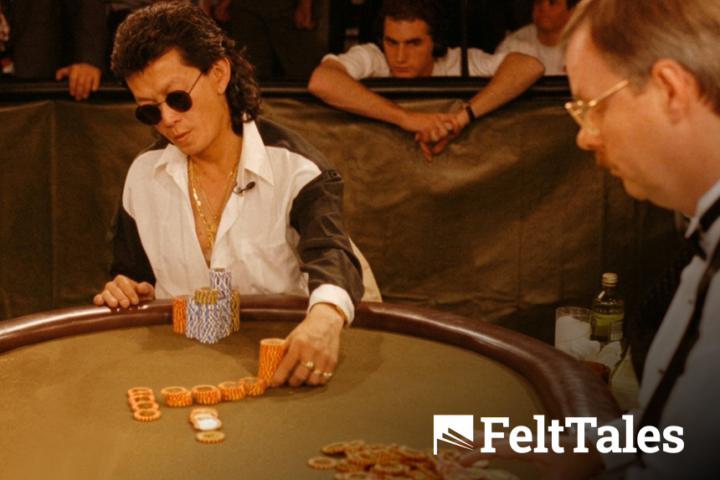
Finally, the hand sits at a turning point in poker history. ESPN’s Bernard Lee wrote that it was missed by most of the poker world because it came before the television era was in full swing. When that era did arrive, the long-haired Ferguson, with his trademark hat and sunglasses, had a head start: Card Player wrote in 2008 that he had gone on to become one of the most recognizable poker players in the world.
The Other Side: Cloutier’s Near Miss and Ferguson’s Fall
For Cloutier, the result was a second Main Event runner-up finish. ESPN notes that he had also finished second in 1985, losing to Bill Smith. He already owned four WSOP bracelets, according to ConJelCo, and Card Player reports that he was inducted into the Poker Hall of Fame in 2006, but the world championship never came.
Ferguson’s story turned darker. He went on to win six WSOP bracelets in total and the 2008 NBC National Heads-Up Poker Championship, according to PokerNews. But he was also a director of Full Tilt Poker, and after online poker’s Black Friday on April 15, 2011, the U.S. Department of Justice amended its civil complaint to allege that Ferguson and other directors had been running what it called a “global Ponzi scheme”. Ferguson denied the allegations through a lawyer. Card Player reports that he settled his civil case without admitting wrongdoing and was never charged criminally, while Full Tilt players were repaid only after PokerStars bought the site.
Ferguson stayed away from the WSOP until June 2016. Asked by PokerNews whether he had anything to say to former Full Tilt players, he repeated: “I’m just here to play poker.” A year later he was named 2017 WSOP Player of the Year, after winning his sixth bracelet at WSOP Europe, according to PokerNews.
Common Myths About the Hand
Myth: Ferguson needed exactly a nine. After the turn paired the kings, a four or a deuce would have split the pot. Ferguson had nine cards that would have kept him alive: three nines to win and six cards to chop, as ConJelCo’s report explains.
Myth: Cloutier was outplayed throughout heads-up. Card Player describes Cloutier climbing from a huge deficit to a slight chip lead before Ferguson edged back in front. The final hand came after a genuine fight, not a one-sided rout.
Myth: Cloutier never won at the WSOP. He never won the Main Event, but he already had four bracelets by 2000, according to ConJelCo.
Myth: Everyone watched it on TV. According to ESPN, most of the poker world missed it at the time.
More Famous Hands and Stories to Read Next
The 2000 final hand belongs to a short list of Main Event endings that are still retold. Twelve years earlier, Johnny Chan finished off Erik Seidel in the 1988 final hand that Rounders made famous. Three years later, an amateur’s nerve produced the bluff that sparked the poker boom, and the full story of how Moneymaker’s 2003 win changed poker explains why the years after 2000 felt so different. For the technology that later put hands like this on television, read about how the hole-card camera turned poker into TV. And since Jim McManus reached the 2000 final table through a qualifier, the guide to how WSOP satellites work shows how that path still operates.
Frequently Asked Questions
Sources & References
- Card Player — WSOP: History — 2000 Recap
- ConJelCo — 2000 World Series of Poker, Championship Event Results and Report
- ESPN — The top 10 hands from 2000 to 2009
- PokerNews — Maligned Champion Chris Ferguson Returns to the WSOP
- Card Player — Chris Ferguson Enters World Series of Poker Tournament
- PokerNews — Chris Ferguson Player Profile