

KEY TAKEAWAYS
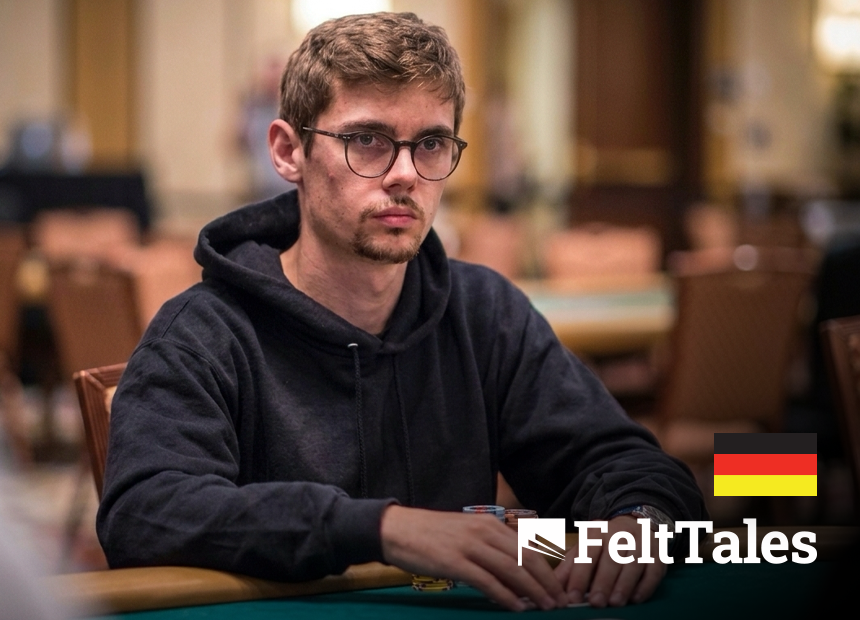
In a long conversation with host Ben Berndt on the German podcast {ungeskriptet}, published on YouTube in October 2025, Fedor Holz walked through how he went from a home game with school friends to becoming Germany’s all-time leading live tournament earner. He described the system behind his best years, explained why a bet that fails most of the time can still make money, and revealed that he had lost about a million the day before the recording through a stake in another player, yet said he was still relaxed about it. The interview was conducted in German; quotes were translated by FeltTales. Recorded a few months before Holz stepped back from his GGPoker ambassador role in March 2026, it also offers an early look at the post-poker plans he has since made public.
Where Holz Said It
The conversation ran on {ungeskriptet}, a German interview podcast hosted by Ben Berndt, under the title “50 Millionen mit Poker: So habe ich sie ausgetrickst” (“50 million from poker: how I outsmarted them”). According to the video description, it was recorded on September 30, 2025, and published on October 29, 2025. It runs close to two hours and fifty minutes. Berndt, who says on air that he has almost nothing to do with poker himself, steers the talk from Holz’s school years through his strategy, his attitude to money and his plans for the years ahead. Holz speaks throughout in German.
Video: {ungeskriptet} — {ungeskriptet} by Ben, published October 29, 2025.
From Chess Club to a Home Game
Holz described himself as a curious, fast-learning child who was badly underchallenged at school. He recalled finishing a full week’s work plan on the first day, skipped a grade in primary school and increasingly felt that he did not fit in. What held his attention instead were games: he learned chess on a school computer, joined a club and played competitively, and later moved on to computer gaming. Asked what drew him in, he said he loves huge, almost endless spaces where the rules set the boundaries and he is free to find his own path.
He also spoke candidly about a very difficult period in his early teens after a family move to Cologne, and said that at 15 he moved to his grandmother’s home in Saarland, where he finished school and found a much stronger circle of friends. Poker arrived there, around the age of 16. Holz said his friends, mostly one to three years older, already played in a regular home game, and that he counted himself as one of the weaker players at the table. When two or three of them began playing online and made a few thousand euros, he said, that caught his attention.
Holz said the mid-2000s were an easy era for online poker, when a smart player willing to put in 1,000 to 2,000 hours could realistically earn 20 to 40 euros an hour. He linked the end of that era to 2011, when American players left the global online games. That refers to “Black Friday”: on April 15, 2011, federal prosecutors in Manhattan unsealed an indictment against the founders of PokerStars, Full Tilt Poker and Absolute Poker and seized the sites’ U.S. domain names. Holz said this made the games much tougher and argued it produced an especially strong generation of players, because his cohort never had the easy money of playing against Americans.
How He Found His Edge
The most detailed part of the interview is Holz’s explanation of how he studied. He asked the listener to picture poker as a landscape of mountains, where each peak is a situation and its height is how often it occurs. The button against the big blind, he said, is one of the highest peaks: a spot he estimated he had been in more than a million times. Studying only that kind of frequent spot in isolation, he explained, is one way to break down an otherwise near-infinite game.
His personal edge, Holz said, came from adding a second dimension. Besides how often a spot occurs, he looked at how big the typical mistake was and how much he could gain by exploiting it. He called this his secret sauce in 2014 and 2015: he picked out 20 to 30 such spots, worked through them in a structured way and built an almost automatic way of playing them without much thought at the table. One example he gave was that professionals of that era folded far too often against small bets, so a steady stream of small bets produced a small profit almost every time.
Holz separated the theoretical foundation from exploitative adjustments. In his view, reading an opponent is worth little without a sound baseline, because a deviation from a bad starting point is still bad. Against a new opponent, he said, he would first test reactions, for example to small bets, and keep using whatever worked until the opponent adapted. He also described a colour-coded system that he and the players he works with use to rate opponents: blue for more passive players, yellow for aggressive ones and green for recreational players, each split into tiers. The strongest players adjust quickly, he said, while against the weakest an exploit can keep working for two years.
Risk Ten to Win Ten: Expected Value Over Results
To show why poker rewards mathematical thinking, Holz used a simple pot. “I risk ten to win ten. So then it has to work 50% of the time,” he said (translated from German). If he bluffs three into a pot of ten, he went on, the bet does not need to work often, and it can fail most of the time while still making money. Most people, he argued, judge such decisions by the bad feeling of losing often rather than by the numbers, and many players in the past simply wanted to win the hand in front of them.
Holz said he played tournaments for about 95% of his career and stressed that tournament variance is far higher than in cash games, since only around 15% of a field gets paid and most of the money goes to the top. He described expected value as a line rising over time with variance as a cone around it: a strong player’s real results can go down over hundreds of events even while his expected value keeps rising. The goal, he said, is to collect expected value in every tournament and separate yourself from the result, which you cannot control.
As an example of a single decisive moment, Holz recalled a pot in a $1 million buy-in tournament with $10 million for first, with five players left, when he was all in against two opponents with pocket tens against ace-king and ace-five, and a ten came on the river. He said he went on to finish second. That matches the 2018 WSOP Big One for One Drop, where Holz’s tens held against Rick Salomon’s ace-king and Byron Kaverman’s ace-five on a river ten, eliminating both. Justin Bonomo won the event for $10,000,000 and Holz took $6,000,000 for second. Holz said the largest cash-game pot he has played was around 2.5 to 3 million euros.
Losing a Million and Staying Calm
The line that gives the interview its hook came when Berndt asked whether big losses are acceptable to him emotionally as well as rationally. Holz said they are. “I lost a million yesterday. That’s okay. I’m still fairly relaxed,” he said (translated from German). He explained that the loss came through a share he held in another player in a high-stakes cash game, and he put it down to bad luck: in a wild game with a lot of money on the table, he said, you sometimes get the money in at 60-40 and the 40 comes in.
Speaking about investing more broadly, Holz said what matters to him is not the result but honesty and respect for the investment. He said he is bothered by being lied to or by the feeling that someone does not take his investment seriously, not by an outcome nobody can control. He described himself as perhaps the best in the world at investing in poker players, citing years of data, and said that losing a million from time to time is part of the game. He noted that he does not plan to raise outside money for this, preferring to work with one or two close friends. The scale is exceptional: at most levels, poker results swing hard, and the game is not a reliable income. For another view of big losses at the top, see Bryn Kenney’s account of losing millions and rebuilding.
Holz drew a line between business and private life. He said his financial decisions are highly quantified, while private ones are intuitive, and described himself as an emotional, sensitive person. Looking ahead, he said he and his partner were planning a family, that he had stepped back from operational work at the poker school he founded about six years earlier, and that he was exploring business succession, restoring old buildings and private equity. He was firm that he would not trade his core principles for higher returns, unless his or his family’s survival were at stake.
Key Moments From the Interview
Why It Matters
Holz’s record gives his views weight. As of March 2026, The Hendon Mob credited him with around $50 million in live tournament cashes, the most of any German player, along with two WSOP bracelets and more than $16 million in cashes in 2016 alone. One of those bracelets came that year in the $111,111 High Roller for One Drop, worth $4,981,775.
The interview also foreshadowed his next steps. In March 2026, Holz announced he would not renew his ambassador contract with GGPoker after six years, saying he was trying to start a family and launching an investment fund. In September 2026 he described that fund, Drafted Ventures, a fund of funds he co-founded with Christoph Zöller, which he said had held a first closing of 15 million euros. He has not disappeared from the felt: in August 2026 he played the €100,000 Super High Roller at EPT Barcelona, telling PokerNews he barely plays anymore.
For fans who discovered poker in the boom that followed Chris Moneymaker’s 2003 win, the conversation is a rare, detailed look at how one of the most successful tournament players of the past decade thinks about risk.
Frequently Asked Questions
Sources & References
- {ungeskriptet} by Ben — 50 Millionen mit Poker: So habe ich sie ausgetrickst (Fedor Holz) (YouTube, October 29, 2025, in German)
- WSOP.com — Justin Bonomo Wins 2018 Big One for One Drop
- FBI — Manhattan U.S. Attorney Charges Principals of Three Largest Internet Poker Companies (April 15, 2011)
- PokerNews — Why 32-Year-Old Fedor Holz, with $50M in Cashes, is Stepping Down from GGPoker
- PokerOrg — ‘It’s been a great ride’: Fedor Holz announces semi-retirement from poker
- brutkasten — Vom globalen Poker-Ass zum Dachfonds-Gründer: Fedor Holz im Interview
- PokerNews — Fedor Holz Still Finds Time for Poker 10 Years After Historic Run