


KEY TAKEAWAYS
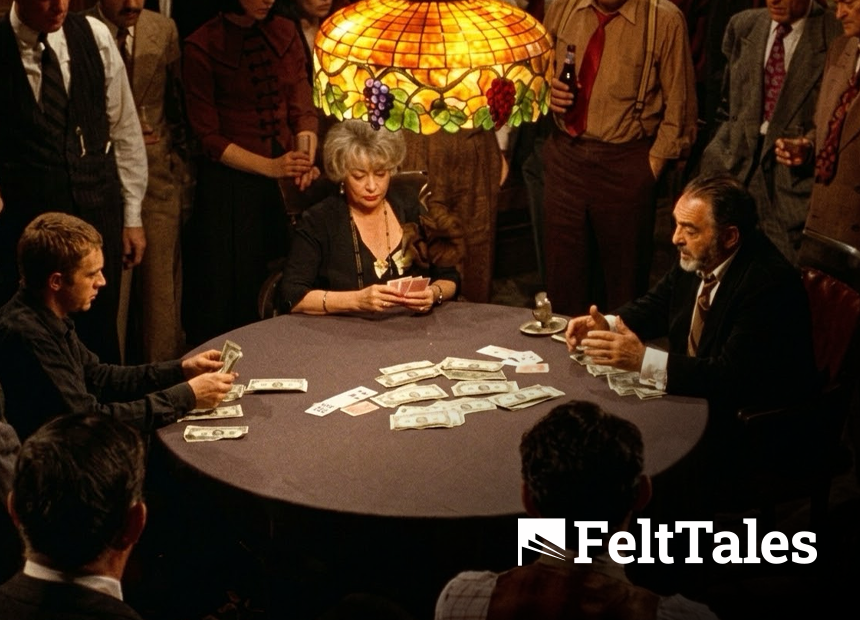
Long before hold’em took over poker on television, a five-card stud game in New Orleans gave Hollywood one of its most argued-about poker scenes. The Cincinnati Kid, released by MGM in October 1965, follows Eric “The Kid” Stoner, played by Steve McQueen, as he takes on the established master Lancey “The Man” Howard, played by Edward G. Robinson. The film ends on a single hand: the Kid’s aces full of tens against the Man’s queen-high straight flush.
That hand has been dissected for decades. Poker writers have called it impossible, then reconsidered; they have calculated its odds and come up with wildly different numbers; and they have argued about whether either player made the right decisions. This article explains how The Cincinnati Kid was made, retells the final hand card by card from published breakdowns, and looks at why a 1965 stud movie still has a place in poker culture, along with the criticisms that come with it.
How The Cincinnati Kid Was Made
The film was adapted from a novel by Richard Jessup, which PokerNews describes as a short pulp novel. According to PokerNews, the novel is set in St. Louis in the 1950s, while the film moves the story back to Depression-era New Orleans. Turner Classic Movies recounts a screenplay that passed through several writers, including Paddy Chayefsky; the credited screenplay is by Ring Lardner Jr. and Terry Southern, as The New York Times’ 1965 review lists.
Producer Martin Ransohoff originally hired Sam Peckinpah. TCM quotes Ransohoff on his idea for the film: “I was interested in doing a gunfight with a deck of cards.” The partnership broke down quickly. On December 8, 1964, The New York Times reported that Ransohoff had suspended production, thrown out the first week’s footage and signed Norman Jewison, after Peckinpah left in a dispute over the unscheduled filming of a nude scene. TCM’s account says Peckinpah was fired after four days of shooting amid broader creative differences.
Casting also shifted. TCM reports that Spencer Tracy was originally set to play Lancey Howard but dropped out over salary, while a later production history from The Magnificent 60s says he left after being denied script approval. Edward G. Robinson took the role, and Joan Blondell played the dealer Lady Fingers, reuniting with Robinson for the first time since 1936, according to TCM. Ann-Margret and Tuesday Weld played the female leads. The New York Times reviewed the film on October 28, 1965, a day after its New York opening, and TCM describes it as one of MGM’s biggest hits of the year.
The Kid vs. The Man: The Final Hand
The game is no-limit five-card stud. Each player receives one card face down and one face up, then three more face-up cards, with a betting round after each, so four of each player’s five cards are visible. By the final hand, PokerNews notes, the other players have dropped out and the Kid appears to be winning, with the Man looking tired after a long session. The action below follows PokerNews’ 2015 breakdown.
Second and third street
The Kid shows the 10♣ and the Man the 8♦. The Kid bets $500 and the Man calls. On the next card the Kid pairs his tens with the 10♠, while the Man catches the Q♦. The Kid bets $1,000, and the Man raises to $2,000 with no pair showing against a visible pair of tens. The Kid calls, leaving $5,000 in the pot.
Fourth street
The Kid catches the A♣ and the Man the 10♦, giving him three diamonds. The Kid bets $3,000, and the Man calls, remarking that it is a reasonable bet, as PokerNews transcribes. The pot reaches $11,000. The Man is still drawing: to a flush, to a straight and, with one specific card, to a straight flush.
The last card
The Kid catches the A♠ for two pair showing, aces and tens, and the Man the 9♦, leaving him four cards to a straight flush on board. The Kid checks, the Man bets $1,000, and the Kid raises his remaining $3,500. The Man then pulls money from his wallet, calls and raises another $5,000, offering to take the Kid’s marker. The Kid calls.
The Man turns over the J♦ for an 8-to-queen straight flush in diamonds. The Kid shows the ace in the hole for a full house, aces full of tens. Lancey’s closing line, as transcribed by PokerNews, gives the film its moral: “You’re good, Kid, but as long as I’m around you’re second best.”
Why The Cincinnati Kid Still Matters to Poker Culture
Few poker films have generated as much analysis. PokerNews calls the final showdown likely the most discussed poker hand in film history, and Card Player has run multiple pieces breaking it down street by street. Roy Cooke wrote in Card Player that he had heard the hand argued for decades.
The film also preserves a version of poker that has largely disappeared from the mainstream. Its game is five-card stud, not hold’em, and its world is private high-stakes games run on trust and markers rather than casino tournaments. PokerNews notes that the setting fits the Depression era and that New Orleans is often linked to the origins of poker.
Its central question has outlived the plot. Ransohoff’s idea of a gunfight with cards frames poker as a duel for status, not just money, and Cooke argued in Card Player that for the characters the game was really about who would be the Man, which changed how much each player was willing to risk.
The Critics: Odds, String Bets and Hollywood Rules
The hand’s harshest critics focus on probability. PokerNews quotes Anthony Holden’s 1990 memoir Big Deal: “In poker terms, the hand is a joke.” Holden put the odds at more than 300 billion to 1 and estimated that the situation would come up once every 443 years of steady play. Michael Wiesenberg, writing in Card Player, put it at worse than 45 million to 1, a very different figure that shows how much these calculations depend on their assumptions.
Wiesenberg also flagged the table conduct. He pointed out that the film is full of string bets, even though the dealer announces at the start of the big game that string bets are not allowed, and he questioned how a player who appears to be all in could suddenly pull more money from a wallet. Cooke noted that both players rearranged their upcards during the hand, which he called against the rules though convenient for viewers.
Not every critic thinks the play itself is wrong. Wiesenberg wrote that after watching the film again he no longer believed the two players would never have played their hands that way, and he walked through why the Man’s calls could be justified by the money he stood to win. The film’s improbable ending, in other words, is a lesson in variance as much as in skill.
Common Myths About the Film
Myth: The game is Texas hold’em. It is five-card stud, with one hole card and four upcards per player.
Myth: The story is set in Cincinnati. The film takes place in New Orleans; the novel was set in St. Louis, according to PokerNews and TCM. “Cincinnati” is the Kid’s nickname.
Myth: Every account of the hand agrees. They differ on details. PokerNews has the Kid opening for $500, while Wiesenberg described the first bet as less than $100, and PokerNews lists the Kid’s hole card as the A♥ while The Straight Dope lists the A♦.
Myth: Jewison directed from the start. Sam Peckinpah began the film and was replaced, as The New York Times reported in December 1964.
Related Stories
The Cincinnati Kid sits alongside other films that shaped how people see poker: how the Rounders movie changed poker culture, Casino Royale’s own straight-flush finale and the true story behind Molly’s Game. For another piece of poker lore that grew in the retelling, read about the dead man’s hand.
Frequently Asked Questions
Sources & References
- PokerNews — Hand Histories: 50 Years of Debate Over the Last Hand of “The Cincinnati Kid”
- Card Player — Implausible Play in The Cincinnati Kid? (Michael Wiesenberg)
- Card Player — A Famous Movie Poker Hand (Roy Cooke)
- Turner Classic Movies — The Cincinnati Kid
- The New York Times — Director Ousted in Film Dispute (1964)
- The New York Times — ‘The Cincinnati Kid’ review (1965)
- The Magnificent 60s — Behind the Scenes: The Cincinnati Kid (1965)
- The Straight Dope — In “Cincinnati Kid,” what hand did Steve McQueen lose to a straight flush?