

KEY TAKEAWAYS
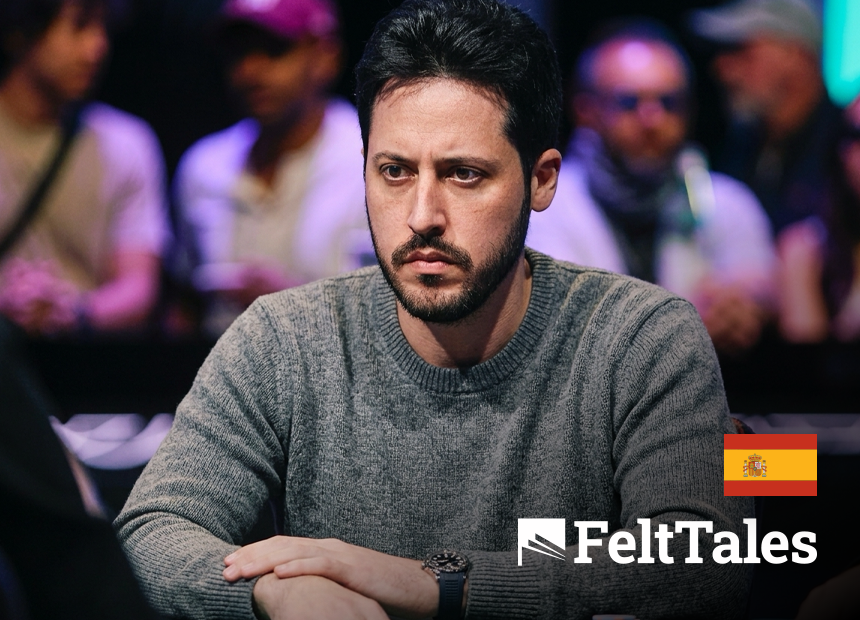
In a long conversation with Raise Your Edge founder Benjamin “bencb” Rolle, published on YouTube on October 30, 2026, Adrian Mateos laid out how he thinks about tournament poker. Over 82 minutes, Mateos discussed why he believes many younger professionals lean on solvers the wrong way, what went through his mind when he folded pocket kings on the feature table of the 2024 WSOP Main Event, and how a period of complacency around 2018 turned into the worst downswing of his career. The timing gave the interview extra weight: it landed a week after Mateos won the 2026 Poker Masters Purple Jacket in Las Vegas, and a few months after he became the youngest player to win six WSOP bracelets. For anyone who wants to know how one of the most successful tournament players of his generation approaches theory, reads and motivation, this is a detailed look, summarized below with the key moments linked.
Where Mateos Said It
The conversation appeared on the Raise Your Edge YouTube channel, the poker training brand founded by online tournament specialist Benjamin Rolle. Mateos joined remotely from London and said his next major stops were Triton in Cyprus and the WSOP series in the Bahamas. The episode runs just over 82 minutes and moves from tournament economics and win rates to his early career, the solver era, live reads and life away from the table, before closing with strategy questions. A recurring thread is how a player who won his first bracelet at 19 has kept competing at the highest stakes since.
Video: The GOAT of Poker on GTO – Podcast with Adrian Mateos — Raise Your Edge, published October 30, 2026.
Why Copying GTO Poker Solvers Is a Mistake
Mateos described the arrival of solvers as a real challenge for his generation, because players who learned before those tools had to change how they thought about the game. But he also argued it left them with an advantage. In his view, many younger professionals skip the basic questions that he grew up asking at every decision: what the opponent is likely to hold, and how often a call needs to win to be profitable. “They just try to copy solver outputs,” he said, calling that approach a big mistake.
His point was not that GTO poker is useless but that it is a starting point. Mateos said players from his era are used to counting combinations and doing simple math at the table, skills he believes are studied far less today. He added that the shift was not instant for him either. When COVID-19 shut down live tournaments, he said, he set himself the goal of becoming a top player in high-stakes online events, struggled for a few months, and only turned things around after a lot of solver work and study with friends. He said he has worked heavily on his online game over the last four or five years and is proud of how that challenge went.
The Kings Fold in the WSOP Main Event
Rolle called the hand one of his favorites and one of the most painful spots imaginable. On Day 5 of the 2024 WSOP Main Event, in a four-bet pot, Mateos held K♠K♥ against Will Berry on a Q♦4♦2♣ flop. Berry bet and Mateos called; on the 10♠ turn Berry bet 1.3 million into 2.21 million, and Mateos folded after about a minute. Berry held pocket aces. Later that same day, Mateos lost a huge pot with aces against ace-king and was eliminated shortly after.
Asked whether the fold was a population read or a read on that specific player, Mateos said it was both. He listed the situation: two of the biggest stacks colliding, what he believed was likely his opponent’s first TV appearance, and a four-bet out of position with roughly 150 big blinds. He said he also picked up physical tells and that his opponent looked very confident, so he concluded that the player would have aces about 90% of the time. Mateos also said the bet sizes were a little bigger than he expected and that, in his experience, players unsure of a spot tend to fast-play their best hands.
Mateos did not present the fold as theoretically correct. He said he knew that, in theory, folding kings there is a big blunder, and that he chose to follow his reads and instincts anyway. He added that big exploits sometimes go wrong, and that being right most of the time is enough to make them highly profitable. “I’m fine making mistakes, big mistakes sometimes,” he said, adding that good players need to be brave enough to make these adaptations. You can read more about how the late stages of the event work in our guide to what a day at the WSOP Main Event is really like.
His Biggest Downswing and the Lesson of Focus
Mateos said success is what nearly derailed him. He told Rolle that he reached No. 1 on the Global Poker Index in 2017, relaxed afterward, and hit the biggest downswing of his career around 2018. “I stopped studying,” he said, explaining that he had a big bankroll at the time and began to feel the game was easy. He added that his losses came less from the tables than from staking many players and investing in businesses that went badly, and that having many people depend on him made one or two years mentally very hard.
Quitting, he said, was never an option, because the best part of his day was still playing. His fix was to cut back on outside projects and concentrate entirely on poker. Mateos said he plays only No-Limit Hold’em, mostly tournaments, because being a specialist is the best way for him to win, and that trying to do many things at once makes a player’s level drop in a field this competitive. He also said that learning to say no did not come naturally to him, and that his best years came after he applied these lessons.
Away from the table, Mateos described a more structured routine. He said that over the last three or four years he has lifted weights four or five times a week, which he credits with more energy and mental clarity at the table, and that he spends time with family and friends in Spain when he can. He also said he studied economics at university for three months before moving to London to play poker, and that investing is the field he would most likely turn to if he ever stepped back from the game, although he considers himself a beginner there and takes the safe route.
Variance, Triton Fields and Beating Your Stakes
Mateos was not surprised by published data showing that many professionals lose money in Triton events. He said samples of 100 or 200 tournaments are small and that tournament poker naturally produces a few big winners and many smaller losers. By his estimate, an eight-handed Triton table usually has about six professionals and one or two recreational players, and he said a player needs to be among the top two or three at the table most of the time to be a big winner. Many pros, in his view, are break-even or small losers. That is a useful reminder that even at the highest level, variance is brutal and poker is not a reliable income; FeltTales has also covered how Fedor Holz thinks about risk and variance.
To check whether he truly beats the games, Mateos said he looks at online results. He considers high buy-in online tournaments tougher than live super high rollers, so a strong win rate there over several years tells him he is winning live too. His advice for players at any level was to track their data over at least six to twelve months, move up when the win rate and return on investment are good and they have the bankroll for the next level, and move down or stay put during a downswing.
Key Moments From the Interview
Why It Matters
Mateos’s record gives his views unusual weight. He won the 2013 WSOP Europe Main Event at 19, captured his sixth WSOP bracelet in the $250,000 Super High Roller in June 2026, and then won the 2026 Poker Masters overall title with 451 points despite five stone bubbles during the series. When a player with that résumé says solvers should be a baseline rather than a script, it carries more than usual.
His comments also land in the middle of a long-running debate about how much modern players should rely on theory versus reads. Mateos did not reject GTO; he called solvers part of his own study and admitted his kings fold was theoretically wrong. What he argued for was a balance: know the baseline well enough to deviate from it with confidence. Equilibrium strategies are designed to be hard to exploit, which is why deviating from them carries risk, and Mateos himself acknowledged that making big exploits opens the door to being exploited. The interview is less a manifesto than a window into how one elite player weighs those risks hand by hand.
Frequently Asked Questions
Sources & References
- Raise Your Edge — The GOAT of Poker on GTO – Podcast with Adrian Mateos (YouTube, October 30, 2026)
- PokerNews — Mateos Folds Kings Correctly in WSOP Main Event; Then Gets Aces Cracked
- WSOP.com — Adrian Mateos Honored at the WSOP After Sixth Bracelet Win
- PGT — Adrian Mateos Wins 2026 Poker Masters Purple Jacket
- Chasing Poker Greatness — Benjamin Rolle: Online MTT Legend & Founder of Raise Your Edge