


KEY TAKEAWAYS
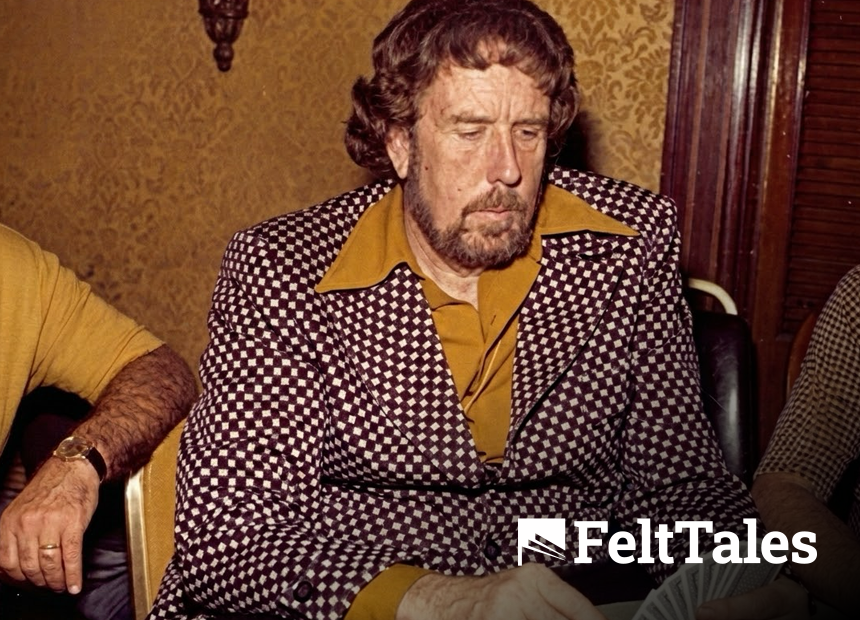
Every tournament player has heard it said, half as comfort and half as a joke: all you need is a chip and a chair. The phrase comes from a real moment at the 1982 World Series of Poker in downtown Las Vegas. Jack “Treetop” Straus, a Texas road gambler, pushed what he believed was his entire stack into a pot, lost, and stood up to leave. Then a single $500 chip turned up on the table. Because he had never said “all in,” he was still alive.
Straus went on to win the Main Event and $520,000, beating Dewey Tomko heads-up. The story has been retold so often that its details have drifted: some versions place the chip under a napkin, others between the table and the rail, and the day it happened shifts from one account to the next. This article retells the chip and a chair story using the documented record from the WSOP, Card Player, PokerNews and the Las Vegas Sun, explains why it still matters to tournament poker, and separates what is known from what has been embellished.
Who Was Jack “Treetop” Straus?
Straus was born on June 16, 1930, in Travis, Texas, according to Card Player and PokerNews. After college he taught for a few years, Card Player reports, before taking up the old Texas-Oklahoma poker circuit, chasing the biggest games he could find. Based in Houston, he followed other Texas road gamblers to Las Vegas in the 1960s and built a reputation as a fearless short-handed player.
His nickname came from his size, though the exact height depends on the source: PokerNews lists him at 6’6″, while the WSOP’s Hall of Fame summary and Doyle Brunson put him at 6’7″. Card Player’s 2008 history of the 1982 series describes a gambler with a famous disregard for money, quoting Straus: “If they had wanted you to hold on to money they’d have made it with handles on it.”
Brunson, as quoted by Card Player, praised his short-handed game: “Jack was an excellent player, an action guy. In a two-or three handed game, he was dynamite.” Card Player also recounts a story from A. Alvarez’s book The Biggest Game in Town in which Straus, down to his last $40 in 1970, bet everything on every wager until he had turned it into $20,000 in less than a day. By 1982 he had played the WSOP for years and reached final tables, but had never won the Main Event.
The 1982 WSOP: From One Chip to the Title
The 1982 Main Event was the first to pass 100 players. Card Player counted 104 entrants, a 25 percent jump from the year before, and noted that big names such as Stu Ungar and Bobby Baldwin went out early in the larger field.
The chip under the napkin
The basic story is consistent across sources. Straus pushed all of his chips into the middle and lost the hand, but he had not announced that he was all in. As he got up to leave, a single $500 chip was found. The WSOP’s own account says it was hidden under a napkin; Card Player’s 2008 history placed it between his napkin and the table bumper; and Las Vegas Sun reporter Jeff Haney, writing in 2009, described a chip stuck between the table and the rail.
Whether he could keep playing was not automatic. Shelton, who worked the 1982 series, told the Las Vegas Sun: “There was a big discussion about whether they were going to let him keep playing.” The ruling went Straus’s way, and the chip stayed in play. CBS News, retelling the story in 2007, wrote that he moved all in on the next hand, won, and doubled again.
From 500 to the chip lead
The recovery was fast. According to Card Player, Straus finished the second day with 90,000 chips and the third day with 341,500, which made him the chip leader of the tournament. At the final table he eliminated Carl Cannon, Sailor Roberts, Buster Jackson, Dody Roach, A.J. Meyers, Doyle Brunson and Berry Johnston in turn, Card Player reported. PokerNews lists Brunson’s fourth-place prize as $52,000.
The final hand against Dewey Tomko
Heads-up, Straus faced Dewey Tomko, whom CBS News described as a former kindergarten teacher. According to Card Player, the match was about ten minutes old when Tomko bet 100,000 before the flop, Straus re-raised 180,000 more, and Tomko moved all in. Straus held A-10 and Tomko A-4, so Straus started the hand ahead.
The board came 6-5-4, giving Tomko a pair of fours, then a queen. Card Player’s Bob Pajich, describing the broadcast footage, wrote that Straus shrugged when the four landed. The river was a ten, giving Straus a pair of tens and the 1982 world championship. PokerNews reports that he won $520,000, the first time a Main Event winner had taken home more than half a million dollars. Card Player notes it was his second WSOP bracelet.
Why the Chip and a Chair Story Still Matters
The story gave tournament poker its most famous saying about survival. CBS News summarized its meaning in 2007: as long as a player has a chip and a seat, there is a chance. The WSOP credits the phrase to Straus’s comeback, and PokerNews calls it an encouraging refrain for players who are short-stacked.
It also captures something true about tournament structure. In a cash game, a player who loses a big pot can simply rebuy; in a freezeout tournament, the last chip is the last chance, and the rules decide whether a player is out. Straus’s case turned on a verbal declaration he never made, and on officials deciding that a single overlooked chip still counted.
The saying keeps resurfacing whenever a short stack comes back. The Las Vegas Sun noted in 2009 that the 1982 tournament was invoked more than once during that year’s Main Event final table, 27 years later.
The Other Side of the Legend
For all its romance, the chip and a chair story is an outlier, not a strategy. Straus was a rare case among 104 players, and for every short stack that recovers, many more are eliminated. The phrase describes possibility, not likelihood.
Straus himself lived with the swings that came with his style. Card Player describes a life of massive windfalls and equally massive losses, and a player who stood in card rooms with empty pockets more times than anyone could count. A year before his win, as PokerNews recounts from Alvarez’s reporting on the 1981 series, he complained that the prize pool was split among the top finishers, arguing that the winner should take everything.
His life ended at the table. Straus died on August 17, 1988, during a high-stakes game at the Bicycle Club in Los Angeles. PokerNews gives the cause as an aortic aneurysm, while the WSOP and Card Player describe a heart attack. He was inducted into the Poker Hall of Fame later in 1988, according to PokerNews and the WSOP.
Common Myths About the Chip and a Chair
Myth: It happened at the final table. The sources reviewed here do not support that. Card Player’s 2008 history says early on day one, PokerNews says the second day, and the comeback then took him to the chip lead before the final table.
Myth: Everyone agrees where the chip was. They do not. Card Player’s Bob Pajich wrote in 2013 that it was found under a napkin, a newspaper or the rail, depending on who told the story.
Myth: Straus invented the phrase that day. Pajich doubted that he was the first person to say it, but the phrase became attached to Straus because of his run.
Myth: The final hand was a dominated hand that held. Straus was ahead with A-10, but Tomko paired his four on the flop. Straus needed the ten on the river.
Related Stories
Stu Ungar, one of the early casualties of the 1982 field, later staged a comeback of his own, retold in Stu Ungar’s 1997 WSOP comeback. Doyle Brunson, whom Straus knocked out in fourth, is profiled in his career and legacy, and the Horseshoe where it all happened is covered in Binion’s Horseshoe, the original home of the WSOP.
Frequently Asked Questions
Sources & References
- WSOP.com — #34: Jack Strauss
- WSOP.com — The Poker Hall of Fame Nominations Now Open
- Card Player — WSOP History: 1982 Recap
- Card Player — Men of Action: Jack “Treetop” Straus
- PokerNews — History of the World Series of Poker Main Event: 1980-1989
- PokerNews — Jack “Treetop” Straus player profile
- Las Vegas Sun — ‘A chip and a chair’ axiom proven again at World Series of Poker
- CBS News — “All You Need Is A Chip And A Chair”